
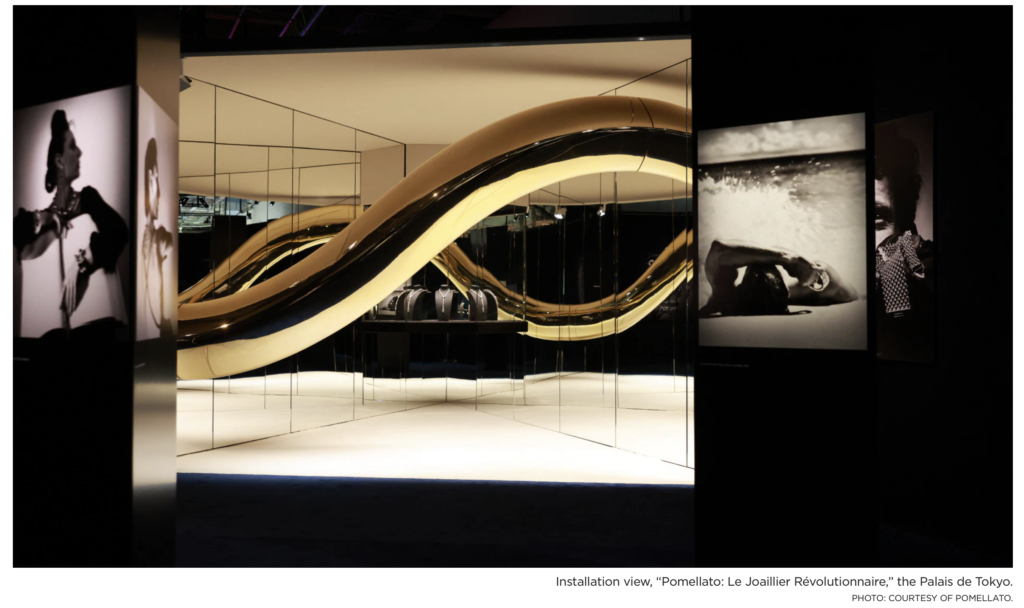
How did a historic Milanese jeweler become a modern revolutionary? That is the central question of “Pomellato: Le Joaillier Révolutionnaire,” a dazzling new exhibition on view at the Palais de Tokyo through July 20. Rather than tracing a conventional timeline, the esteemed Italian jewelry scholar and curator Alba Cappellieri opted to bypass chronological order entirely. “Generally speaking, I don’t like chronological exhibitions,” Cappellieri notes of her decision to structure the show around thematic chapters rather than calendar years. “I am much more interested in why things happened rather than when.”
Cappellieri suggests that Pomellato’s biggest disruption wasn’t just its bold chains or vibrant colored gemstones, but its decision to approach jewelry through (quite literally) the lens of fashion. “You cannot understand Pomellato if you don’t consider the context it came from,” Cappellieri says. “It had a fashion background, not simply a jewelry background. That changed everything.” Founded in Milan in 1967, as Milan was establishing itself as a center of fashion and design, the house emerged alongside prêt-à-porter rather than traditional haute joaillerie. Founder Pino Rabolini—a goldsmith’s son who mingled with artists, designers, and photographers at Milan’s legendary Jamaica Bar—developed friendships that eventually brought Pomellato into the pages of Vogue Italia.
See more here.